Statistical Analysis of Boat Rentals in Sukošan: Trends, Prices and Occupancy
View more


Why did we start this analysis in the first place?
Sukošan as a destination for boat rentals and the chartering of sailboats or yachts remains one of the strongest center of charter tourism in Croatia. Since the marina in Sukošan is one of the largest on the Adriatic, it is clear that a significant share of the town’s overall tourism activity is directly or indirectly connected to this type of holiday.
Each season, thousands of guests, crews and skippers pass through the marina. Yet discussions are often based only on impressions and a general feeling of a “good” or “weaker” year. We wanted to go one step further – to examine concrete figures and see what real data tells us about occupancy trends and average prices over time.
For this purpose, we analyzed publicly available data from a specialized website that monitors the boat rental market in Croatia. These figures proved extremely valuable, as they allow comparisons across multiple seasons, identification of peak weeks and insight into long-term trends.
The goal of this analysis is not merely to present statistics, but to provide context – to understand how the charter segment in Sukošan is developing, how stable demand is, how prices are evolving, and what this means for the future of the destination. The results, we can confidently say, are very encouraging.
Below we present a more detailed overview of occupancy levels and price movements by season.
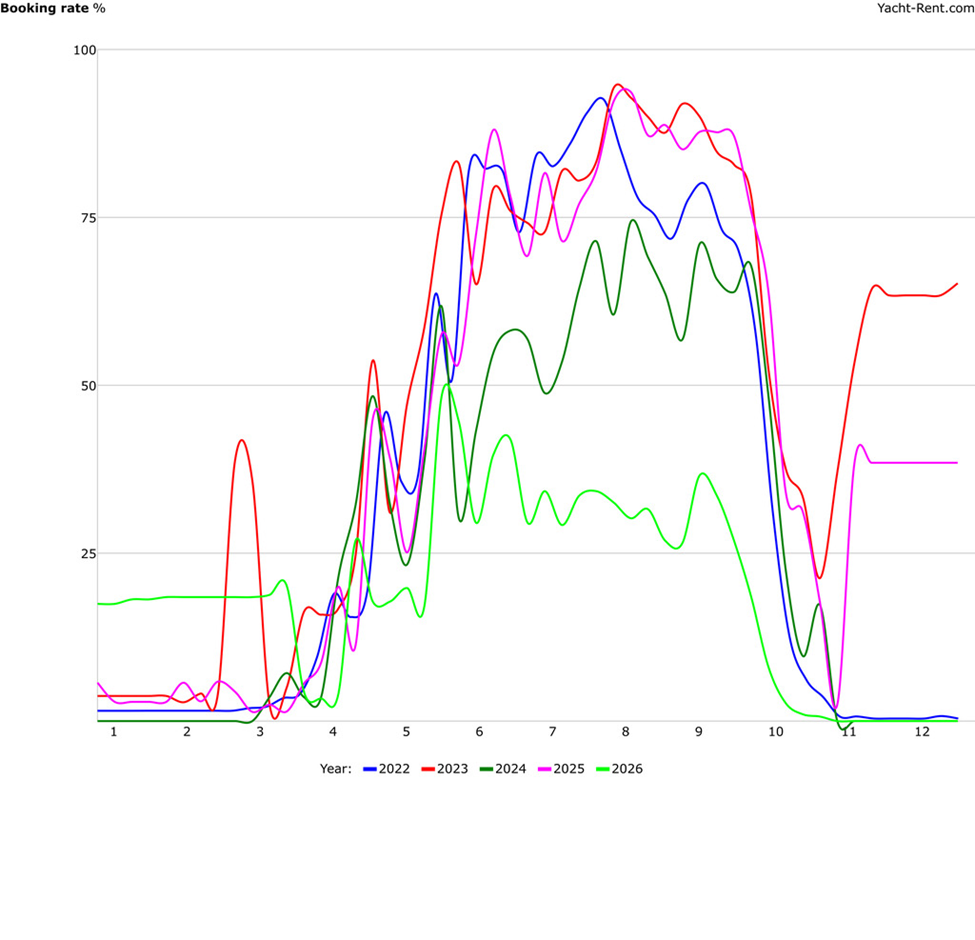
If we look at 2022, we see a clear upward wave from April towards summer. Occupancy rises from 45% at the end of April to over 80% at the beginning of June, reaching a peak of 92.53% on 30.07.2022. That represents an almost fully booked marina.
A year later, in 2023, the peak was even stronger. On 05.08.2023, occupancy reached 94.26%, while the entire month of August remained above 89%. This represents an exceptionally high and stable peak season.
In 2025, we observe a very similar pattern: 93.67% on 09.08.2025. Strong weeks were also recorded in September, where occupancy remained above 87%.
Interestingly, 2024 was somewhat softer, with a peak of 74.36% on 10.08.2024. This may indicate an increased fleet size or a slight redistribution of demand towards other bases.
For 2026, the data is still “live.” The season is ongoing and the peak has not yet reached the levels recorded in 2022, 2023 and 2025. It should also be noted that occupancy figures are updated as new bookings are made.
This is no coincidence.
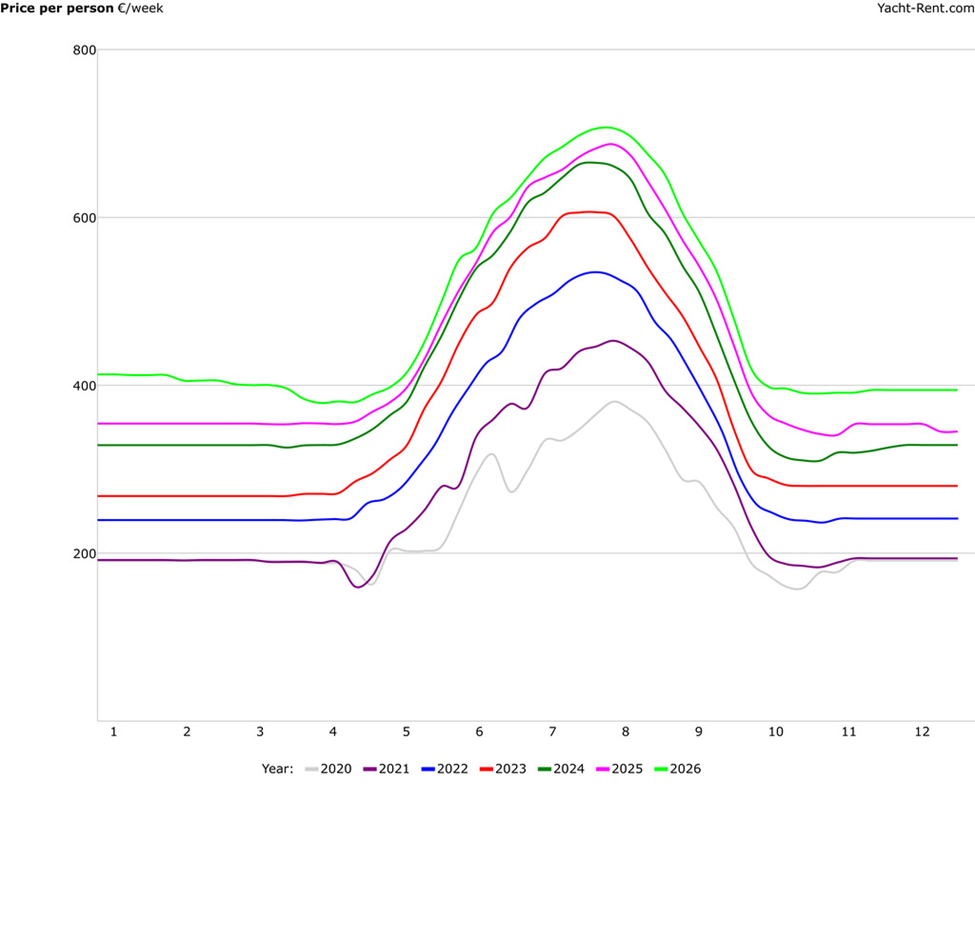
Part of the growth comes from the market recovery following the pandemic years. Another part reflects inflation and rising operational costs. However, an important factor is also the structure of the fleet.
Boats age and their prices naturally decline. At the same time, new vessels are continuously added to the fleet – often larger, more luxurious, with more cabins, or even motor yachts whose prices are significantly higher than standard sailing yachts that form the core of the fleet. When such vessels are included in the statistics, they raise the overall average.
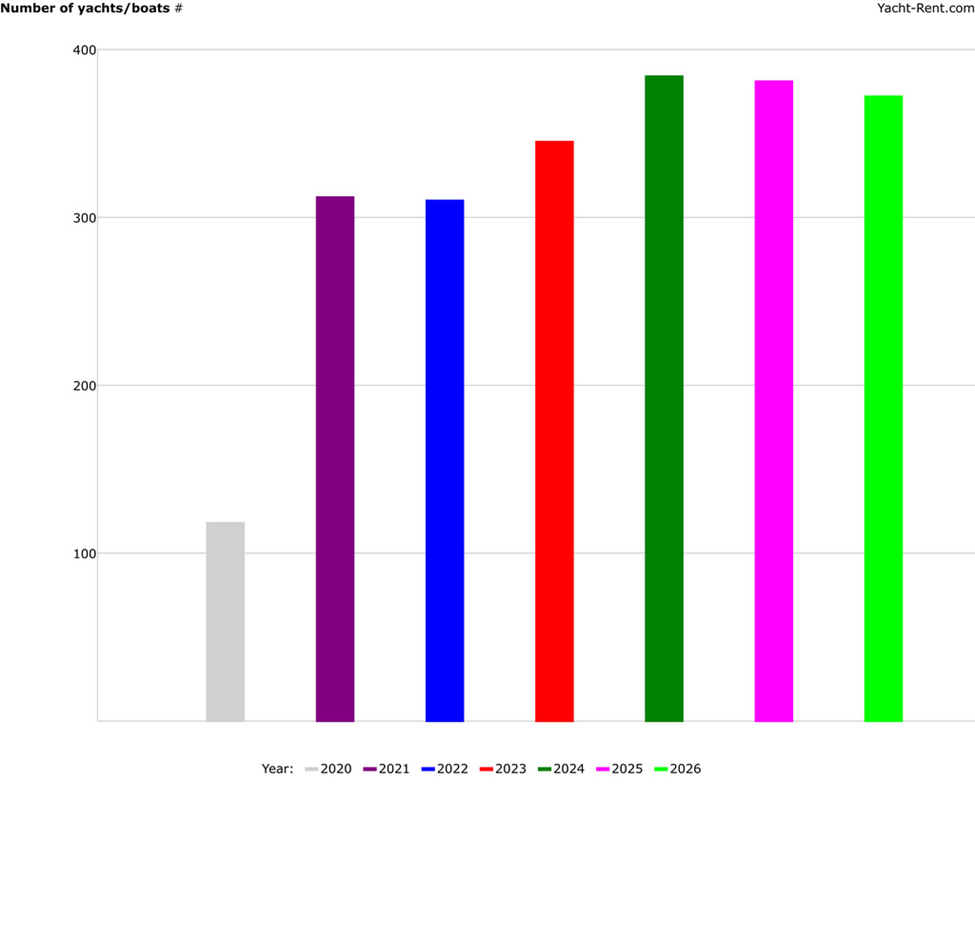
If the number of boats increases while prices continue to rise, this indicates that the market accepts higher value.
We know a simple rule: excess supply lowers prices, while limited supply pushes them up.
In years when the fleet expanded but occupancy remained high (such as 2023 and 2025), we can conclude that demand kept pace with supply. This is a sign of a healthy market.
In 2024, we see slightly lower peak occupancy alongside high prices. It is possible that the fleet was numerically stronger, resulting in a relatively lower occupancy percentage, while total revenue remained high due to price growth.
In other words, percentages alone do not tell the whole story. Context matters.
Sukošan has one major advantage: its proximity to Kornati National Park. For many guests, this is a decisive factor when choosing a charter base. A shorter transfer to the archipelago means more time for sailing and enjoyment.
This geographical advantage stabilizes demand. Even when the market fluctuates, Sukošan remains competitive thanks to its direct logistical benefit.
Occupancy at the beginning of 2026 shows unusually high winter percentages (55–62%). This likely does not reflect actual demand, but rather vessels being marked as “reserved” during maintenance periods. Such data must be interpreted carefully.
However, summer prices are the highest recorded so far. This indicates that the market perceives Sukošan as a premium charter base.
When we connect all the elements – number of vessels, pricing and occupancy – we see a destination that has matured.
Prices are rising because the quality of the offer is increasing.
Peak-season occupancy remains very high.
The market accepts newer, higher-priced models.
The location provides a strategic advantage.
Of course, balance is essential. If supply grows too quickly without proportional demand, prices will adjust. If demand exceeds capacity, prices will continue to rise.
For us in Sukošan, this is encouraging. The figures show stability. And potential.
And that is a message we can proudly share – with guests and partners alike.
Because behind every number stands a real arrival, a real crew, and a real week spent at sea.
Data source for yacht rentals in Sukosan: Yacht-Rent.com


